
|
|
|
|
Got a hint? You're welcome to submit news ideas.
Contact admin@manuatele.net Source: Samoa News

|
Press Releases_
ASCC Instructor Contributes to Breakthrough Research on Polynesian Migration
by James Kneubuhl, ASCC Press Officer
Archaeology instructor Dr. David Addison of the American Samoa Community College (ASCC) has coauthored a paper that appeared this week in the prestigious Proceedings of the National Academy of Science. The paper, titled "Radiocarbon and DNA evidence for a pre-Columbian introduction of Polynesian chickens to Chile," and written in collaboration with scientists in New Zealand, Chile, Australia, Hawai'i, and Canada, has caused enough of a stir within the academic community that it made national news headlines earlier this week. For decades, scientists have only speculated that ancient Polynesian voyagers may have reached the shores of South America, but this paper provides the first hard evidence proving that Polynesians did in fact sail all the way to the west coast of the continent at least a century before the arrival of Columbus. Amazingly, the researchers found the key to this breakthrough in an entity most of us would probably consider rather un-scientific, namely chicken bones.
Recently, archaeologists in Chile found chicken bones which they subsequently radiocarbon dated as approximately 600 years old. Using DNA testing, Alice Storey of the Allan Wilson Centre for Molecular Ecology & Evolution at the University of Auckland discovered that the bones from Chile carried a rare mutation otherwise only found in chickens from Mele Havea, Tonga, and Fatu-ma-Futi, American Samoa. Previously, scientists commonly believed that the chicken, not indigenous to either North or South America, arrived on the continent along with Spanish explorers in the 15th century. However, if Chileans in fact possessed chickens at least 100 years before Columbus reached America, and these fowl carried DNA identical to chickens found in Tonga and Tutuila, this evidence clearly indicates a pattern of interaction between Polynesians, long recognized as some of the world’s finest sailors and navigators in times preceding Western contact, and South Americans. To put it simply, Polynesians not only made it to America before Columbus, but they apparently introduced the chicken to the continent, as well.
Dr. Addison, who holds a PhD in Anthropology from the University of Hawai'i, spent seven years in the Territory working for ASPA before joining the ASCC faculty last year. Describing the chain of events which led to the recent scientific breakthrough, he recalls, "I have a longstanding relationship with the Allan Wilson Centre for Molecular Ecology & Evolution at the University of Auckland. The center's founder and director, Dr. Elizabeth Matisoo-Smith, an old friend of mine, visited ASCC in October, and attended the Archeology of the Polynesian Homeland conference here in December of last year.
"Alice Storey, a PhD candidate whom I've also known for years, studies at the University of Auckland under Dr. Matisoo-Smith, and specializes in chicken DNA. She uses it to understand the movement of Polynesians into the Pacific, and their subsequent contacts and interaction between islands. Because Polynesians carried the first chickens to every island, the DNA provides a 'family tree' of those chickens which we can use to trace which ones are related. When we found chicken bones while digging at the Fatu-ma-Futi site as part of the ASPA sewer project, I immediately contacted Ms. Storey and Dr. Matisoo-Smith about the possibility of doing ancient DNA analyses on the bones. Ms. Storey then tested them and compared them with samples from Tonga and South America."
Dr. Addison went on to explain that the site digging at Fatu-ma-Futi was done in compliance with Section 106 Federal regulations about archaeology, which all local agencies using Federal funding are required to follow. "This is an example of why those laws benefit American Samoa, and are essential to helping us understand our past," he said. "If it wasn't for the Section 106 law, American Samoa would never have provided a key component in this discovery, and the world wouldn't know about the important role Tutuila and Manu'a played in the history of the whole Pacific."
Prior to joining the ASCC faculty, Dr. Addison spent seven years doing field research in Tutuila and Manu'a. His work has also taken him to many locations in the Pacific, including Hawaii, the Marquesas Islands, and Palau. "So much of what really happened in the past remains a mystery," he reflected. "Archaeology lets us discover something new by studying something old, and I enjoy familiarizing the young men and women of American Samoa with the knowledge, techniques and philosophies associated with this field."
Tufele dismisses any move for a separate Manu'a government
By Blue Chen-Fruean
Samoa News Correspondent
May 2, 2007
Manu'a District Governor Tufele Li'amatua has written a letter to Congressman Faleomavaega, voicing his opinion on, among other things, suggestions that the Manu'a Islands should set up its own separate government.
In his letter, Tufele acknowledges and thanks Senator Daniel K. Inouye for his great assistance to the people of Manu'a. He also addresses several issues Congressman Faleomavaega has brought to the fore recently concerning Manu'a.
Tufele says that as chairman of the Future Political Status Study Commission (FPSSC), it is important at this time "to put to rest statements which have been made regarding the future political status options for the Manu'a Islands," particularly the notion that Manu'a should set up its own separate government.
He described the Manu'a people as "loyal and proud Americans of American Samoan ancestry."
"Culturally, economically, socially, geographically, and politically, such a political option would not reflect the wisdom which moved our forefathers to define and promote our current relationship with the United States," Tufele wrote.
He referred to the fact that Tutuila and Manu'a have received "unprecedented and unparalleled benefits and goodwill as a result of our affiliation with the United States," and as FPSSC chairman, Tufele said he has maintained that the present relationship with the United States is serving our very aspiration.
"American Samoans are free to travel and set up residences in the United States," he continued. "We continue to boast that we still own our lands and are free to practice our cultural traditions."
"You have often raised the point that we must decide whether American Samoans wish to become US citizens and I concur that the question must be answered."
However, Tufele says that the privileges do have latent costs, which must be clearly identified, discussed, and understood, before any question is asked.
He points out that with the exception of the privilege to vote for the President of the United States, American Samoans enjoy practically all of the privileges accorded to U.S. citizens.
"Our people are extremely patriotic, evidenced by the highest per capita enlistment rate in the United States Armed Forces, protecting the basic freedoms that Americans treasure," Tufele pointed out.
Tufele said that while their approaches might vary and interpretation of circumstances may yield differing perspectives, "we all agree that our intentions all center on our individual commitments to improve the lives of our people."
"I refuse to accept the thinking that politics causes divisiveness. Political maneuvering which causes the lives of our people to improve is good politics," continued Tufele. "Since the common thread which binds us together as political leaders is to improve the welfare of our people, we should be working together to advance this desire. Collaboration, in my humble opinion, guards against waste, not only in terms of money, but also in terms of time."
He said he is "thrilled" that the needs of the Manu'a Islands have been afforded tremendous attention, but he is also very cautious of his jubilation.
"Funding earmark is only the beginning step of the process. Implementation is the key. It would be unfair not to acknowledge the efforts of the Governor and the Fono, who I extend my thanks to for recognizing the needs of Manu'a," said Tufele. "It is my hope that in the future, we will present the needs of American Samoa through a unified front so that the Congress of the United States is clear and under locally determined priorities."
Reach the reporter at blue@samoanews.com.
(c) Osini Faleatasi, Inc. dba Samoa News reserves all rights.
Senate calls for Eni to withdraw ballot proposal
Congressman didn't consult with leaders and the public, resolution says
By Fili Sagapolutele
Samoa News Correspondent
May 1, 2007
The Senate has requested Congressman Faleomavaega to withdraw a federal measure he introduced in the U.S. House seeking the Secretary of Interior to place three questions on the November 2008 ballot.
The questions are 1st) whether individuals who are born in American Samoa should become citizens of the United States; 2nd) whether Senators should be elected by the qualified electors from the respective counties; and 3rd) whether American Samoa should have its own Federal district court with limited jurisdiction.
The Senate's request is outlined in a Senate Resolution, signed by 17 senators, conveying its "strong opposition" to the proposal. The missing signature is Sen. Faiivae Galeai, who has been absent since the start of the Special Session due to health reasons.
Prior to the close of the First Session in March, Faiivae had argued that its up to Faleomavaega as to what bill he wants to introduce in Congress and challenges his colleagues as to what they are afraid of, having such questions placed on the ballot.
The "Senate strongly opposes this legislation which it feels the Congressman unilaterally and without proper consultation with the leaders and people of American Samoa introduced," the resolution says.
Regarding the issue of persons born in American Samoa to become a U.S. citizen, the Senate says this matter has been the subject of comment in the territory's history "as far back as our forefathers who established milestones in our development, to the political status study commissions and constitutional conventions of more recent times."
"During these occasions the people of American Samoa concluded that U.S. National is the appropriate status for themselves and their future generations because of the conditions that make life in this small island community uniquely different from that which exists in the United States," the resolution said.
In the matter of electing Senators, the resolution points out the "wisdom of our forefathers to institutionalize Samoan culture in the decision making process of modern government, by mandating that members of the Senate.....be elected by Samoan culture, assures the preservation of a way of life that is directly dictated by the physical and spiritual environment in which the Samoans live."
The resolution notes the "people of American Samoa acknowledge with humility the material and spiritual benefits received through their relationship with the United States based on the values of mutual love and respect."
It further states that the "Senate believes that the issues that have direct impact on the future political status and the preservation of our way of life, such as those raised by Congressman Faleomavaega in Congress, must emanate from within American Samoa."
The Senate therefore requests Faleomavaega to withdraw this measure from Congress in favor of awaiting public discussions in the territory.
Copies of the resolution were to be forwarded to Governor Togiola, Interior Secretary, House Speaker Savali Talavou Ale, U.S. House Speaker Nancy Pelosi; Hawaii's congressional delegation and other Congressional members.
Reach the reporter at fili@samoanews.com.
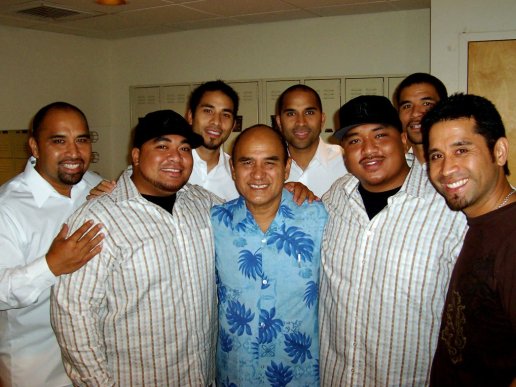
The Katinas on their My Samoa Tour pictured with their father Pastor Mose Katina and New Zealand's Adeaze during the My Samoa concert in Hawaii. Scheduled appearances for 2007 continue in Fayetteville, North Carolina on February 17th and in Oceanside, California on February 23rd. More details available at www.thekatinas.com. (Contributed by: Evelyn)