 |

|
| Home Page |
|
Comments and Greetings | Add New Site | Basic Samoan | Travel |
Got a hint? You're welcome to submit news ideas.
News_
SSG Uilisone Tua receives top honors
(Written by MAJ Laupola)
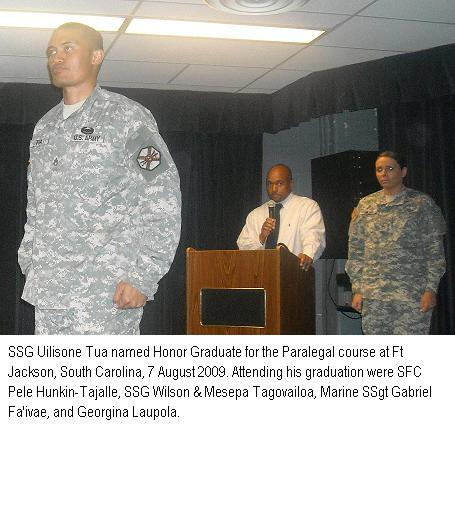 SSG Uilisone Tua receives honor graduate during his graduation from the Army's Legal Specialist course (27D)at Ft Jackson, South Carolina, Friday 7 Aug 09. SSG Tua was selected for this honor because of his highest academic achievements on all tasks; written, oral, hands-on and leadership examinations during this 10-week course.
As a paralegal specialist, SSG Tua will be an integral part of the Army's legal system. He will assist judges, Army lawyers and unit commanders on all legal and judicial matters. He will also provide legal and administrative support in areas such as criminal law, family law, international law, contract law, and fiscal law. SSG Tua will also be involved in defense and judicial legal services as well as operational and foreign law.
SSG Tua hails from the village of Fagasa, Amerika Samoa. He is the son of the late Tua Falemanu and Pisao Pakisa Tausaga. Receiving top honors for his academic achievements is not new to SSG Tua. He was the Valedictorian for the Samoana High School class of 2000 and a recipient of the ASG off-island scholarship. SSG Tua is currently a 3rd year student at the William Richardson School of Law, University of Hawaii and is assigned to the 3304 MSB, USAR, Ft Shafter, Hawaii. In 2004-2005, he deployed to Iraq with the 793rd Engineer Detachment from American Samoa.
Immediately after the graduation, SSG Tua was guest of honor at a farewell get together hosted by SFC Pele Hunkin-Tajalle, SSG Wilson and Mesepa Tagovailoa and SSG Sivailoa Uso. Before SSG Tua departed for Hawaii, he thanked his Samoan family at Ft Jackson for setting a great example and always there to support Samoan service members that are trained at Ft Jackson, SC. He also thanked his families in Fagasa for their continued support and especially Reverend Falelua Lafitaga of the Kanana Fou CCCAS, Hawaii and the Congregation for their prayers.
Send congratulatory message to SSG Uilisone Tua at uilisone@hawaii.edu
Response to Advertiser story - "Wounded Hawaii warrior seizes new mission with Army support"
Talofa. God is good, all the time! His will be done through men and women of faith no matter the cost, the burden or thoughts of this world. "stand up against.. and having done all (the crisis demand), to stand (firmly in your place)." Eph. 6:13 AMP. To resist and to stand; not to battle, not to fight- that has already been done, in Him we win. It does however say to resist, so there is something that WILL come against and rise or TRY to rise against what we stand for. It's a fixed race, we win. But in order for victory we must stay the course and enforce what is already ours, already done. Victory through Him.
I want to thank you for your blessings, your prayers and love through your responses. The amount or offering of any kind whether of labor or spiritual gratitude is more than I can ask or request of anyone or group. I thank you as a Soldier, a husband, a father, a son, a brother, and a friend. Know that this shall come to pass as I stay on duty to God and this country I love. My apologies for not returning any phone calls or answering any emails. I have been working to straighten details out since the release of the story. I was caught off guard by the dramatic passion the newspaper staff poured into the article once they agreed to bring awareness to the public of my situation. The very reason the military has procedures and protocols in place to counter or assist in such stories or events before posting to the public. It was to be a specific 'asking for help' call in the paper, just that, short and simple and certainly not front page material. I read a lot of self pity and that which is not of me or my character in this story and was very embarrassed by it. After struggling to finish reading I feel that my name and condition was used to speak on other things as well, like the WTU (Warrior Transition Unit), mentioning of classified locations (which is no secret) and making it sound pitiful that the Army, (my unit), Special Operations Command, the organizations with it as well as the ones who profit nothing, and that the men and women in my outfit did nothing for me. Quite the opposite and very untrue.
Yes, I do need help with payment for my home modifications and that the VA is... special. I did break my neck in that fall but am grateful to God I was able to recover and push out. I continued on in the following weeks with an on and off sharp pain in my neck while still fully able, until later disconnecting an already fractured vertebrae pinching off my spinal cord resulting my current condition. I do talk with soldiers coping with this evil called depression, bringing hope and direction through prayer. I am recovering far beyond what I am supposed to be knowing that this shall come to pass and a testimony will be preached. What is done to embarrass and shut me up has brought me out, not by flesh but of this world.
And now, regardless of all that has been said and done, I want to thank you the people of Hawai'i both locally and outskirts for the outpouring of your love to this story. Our wounded, both active and retired across the nation do or could use our help, to ask or find out is one way. There are many wounded soldiers amongst us. There are those with injuries that is visual and in plain sight like mine, and then there are those whose injuries are within and not in plain view at all.
Sualauvi M. Tuimaleali'ifano III
|
SGT Lafoga Leama Dedicates Green Beret to Grandmother
Written by MAJ Tauapai Laupola
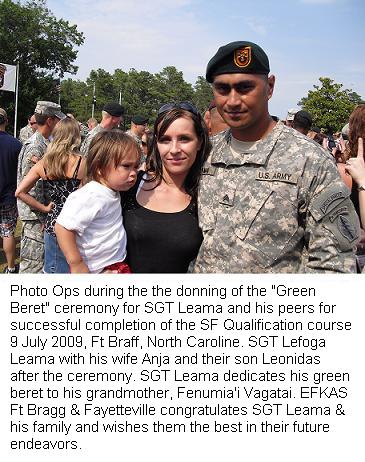
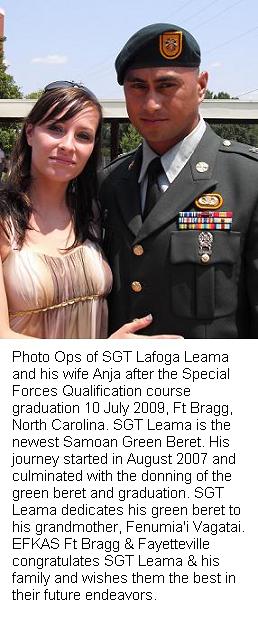 SGT Lafoga, Leama dedicates the donning of his “Green Beret” to his grandmother, Fenumia’i Vagatai of Ofu, Manu'a who passed in December 29, 2008. The newest Samoan Green Beret graduated from the Special Forces Qualification Course on 10 July 2009, and is now part of the Army's Special Forces (SF)'— the Army's most specialized experts in Unconventional Warfare. SGT Leama will be assigned to the First Special Forces Group, Ft Lewis, Washington.
SGT Leama hails from the village of Ofu, Manu’a. He is the son of Vaouli Leama and Afioga Leama. He is a member of the Poly Tech’s 2003 graduating class. Before he joined the regular Army, he was a member of the USAR, Tafuna, AS. He is married to Anja A. Leama of Germany and they have a son, Leonidas Leama.
When asked about his accomplishments, SGT Leama replied, it's an honor to be able to complete the SF Qualification course and am humbled to don the Green Beret. This has been a long and grueling journey that started in August 2007. To don the Green Beret and be considered a member of the SF is a dream come true. I could not have made it without the prayers and support of my parents, families and especially my church, Ekalesia Faapotopotoga Kerisiano Amerika Samoa Ft Bragg & Fayetteville. This Green Beret is dedicated to my parents and especially my grandmother, Fenumia'i Vagatai. "I love you grandma, it's your son, Lafoga."
The Ekalesia Faapotopotoga Kerisiano Amerika Samoa Ft Bragg & Fayetteville congratulates SGT Lafoga Leama and his family for this great accomplishment and wish them well in their future endeavors.
Send congratulatory messages to lafoga.leama@us.army.mil
18th Annual Conference of F.A.G.A.S.A. Incorporated Society
Tauapai Laupola
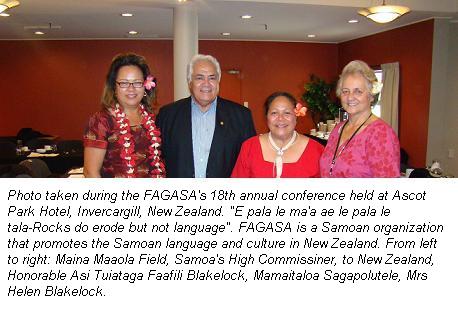
Faalapotopotoga Mo Le Aoaoina o le Gagana Samoa i Aoteroa (FAGASA), held its 18th Annual Conference at Ascot Park Hotel in Invercargill, New Zealand 13-16 April 2009. The theme of the conference: "E pala le ma'a ae le pala le tala-Rocks do erode but not language". FAGASA is an incorporated organization that promotes the Samoan language and culture in New Zealand.
An ava ceremony kick-off this 4-day conference hosted by the Invercargill branch of FAGASA. Interesting enough, the preparation of the ava ceremony was performed by the Invercargill combined youth groups, the majority of them were born and raised in New Zealand. The Invercargill branch consists of the Methodist Church, the Congregation Christian Church of Samoa and the Assembly of God Church.
FAGASA President, Mr Faatili Iosua Esera, welcomed the participants of the 18th Annual Conference of FAGASA and introduced the High Commissioner of Samoa to New Zealand, Honorable Asi Tuiataga Faafili Blakelock who officially opened the conference. Honorable Blakelock emphasized the importance of the conference's theme "rocks erode but not language" and thanked FAGASA for its role in the preservation of the Samoan language and culture.
The keynote speaker was Fepuleai Lasei Dr John Mayer. Dr Mayer is the Associate Professor of Samoan language and Chairperson of the Department of Indo-Pacific Languages and Literatures at the University of Hawaii, Manoa. Dr Mayer acknowledged FAGASA's lead role in promoting the Samoan language and culture and providing opportunities for educators to come together and discuss important issues and common concerns in the teaching of the language and culture and in sharing accomplishments.
Dr Mayer elaborated on the close relationship between New Zealand and Hawaii their common desire for the preservation and the cultivation of the Samoan language and culture for the children and to enable them to pass it on to their own children. One of FAGASA's greatest contributions is its ability to reach out to other Samoan communities abroad and build an awareness that we all have the same problems and the same goals for the future. This international focus and cooperation of FAGASA contributed to the establishment of the Faleula o Fatuaiupu o le Gagana Samoa, the International Samoan Language Commission in 2000. In the last nine years, FAGASA has been a leader in the Faleula, not only in issues of the Samoan language, but also in providing an example of how the faaSamoa can remain strong in communities outside of Samoa.
Dr Mayer concluded by describing some of the common concerns that all Samoan communities abroad share in trying to teach Samoan language and culture. These include understanding the differences in how our children learn the Samoan language in Samoa and how they learn the Samoan language in communities abroad; finding additional means of teaching the faasamoa-especially in the classroom; finding new ways to disseminate Samoan teaching materials, perhaps on the internet; working to involve the churches in the education of our children; introducing Samoan language and culture into the public school systems as a subject to be studied by both Samoans and non-Samoan children; training and certifying teachers to teach Samoan language in school; and using the internet to reach distant Samoan communities.
Papers and presentations delivered during this conference included "Le Afi Tunu a Salelesi", "Using of the Samoan Speech Format to Teach Samoan Language", "Reading Assessments for Pre-school", "Teaching Samoan Language in High School at Christchurch", "First Samoan Language School in Honolulu, Hawaii", "Frequently Used Words and Techniques to Teach Them", "Pre-school in Wellington", "Sulaga o Toga" and "Contribution of Samoan Service Members to the Preservation of the Samoan Language and Culture".
Special thanks goes to the Invercargill branch of FAGASA for hosting the 18th annual conference and especially to the outgoing board, President, Faatili Iosua Esera and Secretary/Treasurer, Ms Ester Jane Temukisa Laban for a successful conference. Best wishes to the incoming board, President, Galumalemana Alfred Hunkin, Secretary, Ester Jane Temukisa Laban, and Treasurer, Mele Ah Sam. The FAGASA's 19th annual conference will be held April 2010 in Wellington, New Zealand. "E Pala le Ma'a ae le Pala le Tala-Rocks Erode but not Language".
| HOME | Add New Site | About Us |

